Gulfstream Aerospace: Designing a suite of stress analysis tools for for aerospace engineers

Role
Product Design Intern
Team
1 Product Design Intern
1 UX Engineering Intern
1 Front-End Engineer
1 3D Graphics Developer
1 Project Manager
Timeline
May 2024 - August 2024
Skills
Product Thinking
User Research
Interaction Design
Visual Design
Tools
Figma
FigJam
During the summer of 2024, I was a UX Design and Research Intern at Gulfstream Aerospace within the Stress Analysis department. There were only two UX professionals in the team - me and a UX Engineering Intern. It was an exciting opportunity to blend my engineering background with my UX education as I designed four new internal tools for aerospace engineers in the IEF (Innovation, Engineering, and Flight) Unit.
Being the sole UX Designer brought challenges, from balancing user needs with design best practices to quickly learning complex aerospace workflows. However, I also got the chance to conduct hands-on user research, collaborate closely with front-end engineers and 3D graphics developers, and strengthen my visual design skills, creating high-fidelity prototypes in Figma. This experience made me a better designer by teaching me how to balance user needs with business goals in a complex, technical setting. It pushed me to adapt quickly and focus on creating functional, intuitive tools that enhance engineers’ workflows and drive impactful results.
Disclaimer This design is a recreation. All visuals, including images and icons, were created using publicly available or open-source resources. This design was not produced during my internship, nor does it represent proprietary work or confidential information from Gulfstream.
Project Overview
Increasing productivity for aerospace engineers
I was an intern on the Methods & Simulation (MetSim) team within the Stress Analysis department. The team was developing different kinds of stress analysis tools and resources for engineers across Gulfstream. During my 12-week internship, I worked on designing four tools:
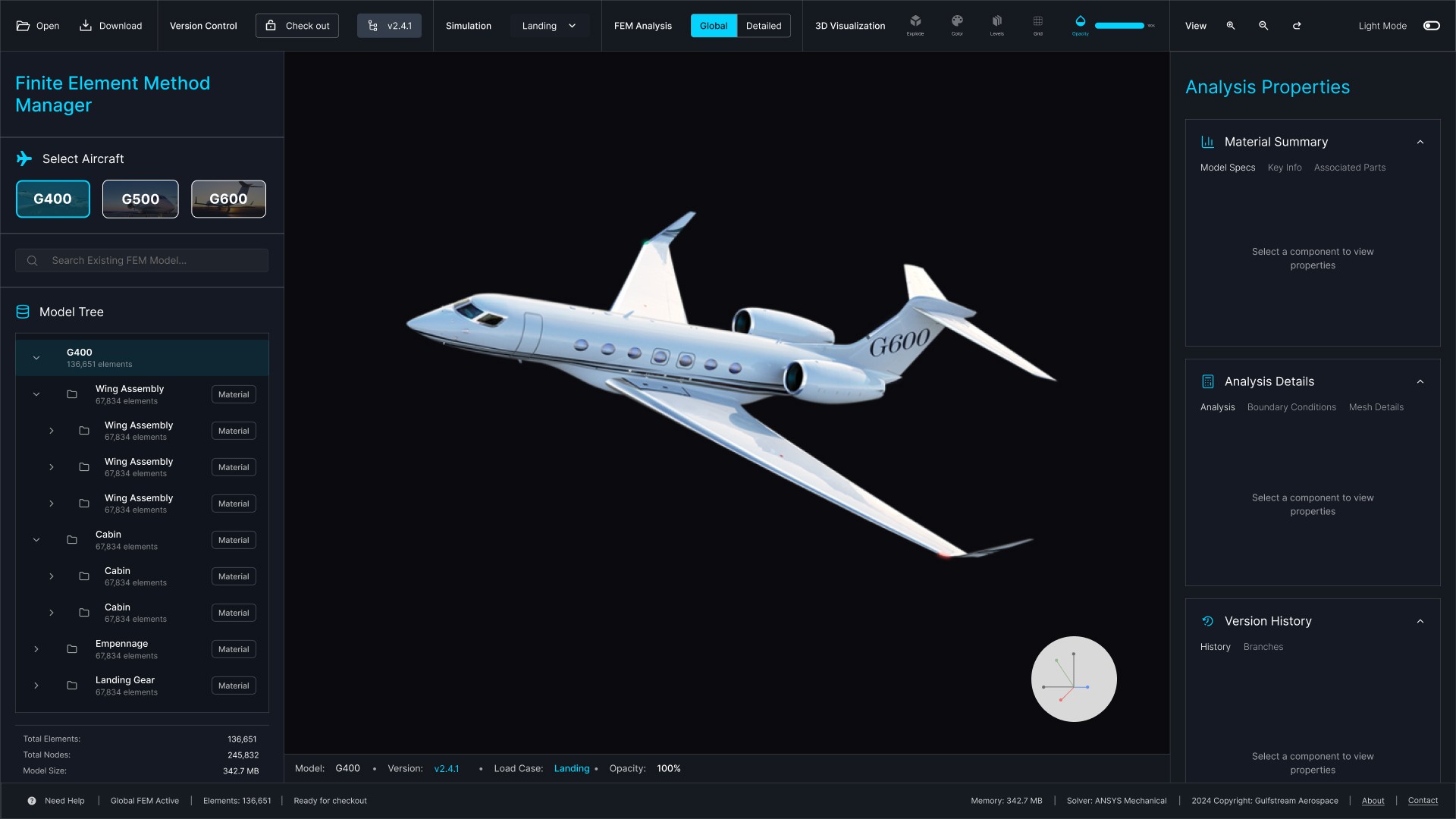
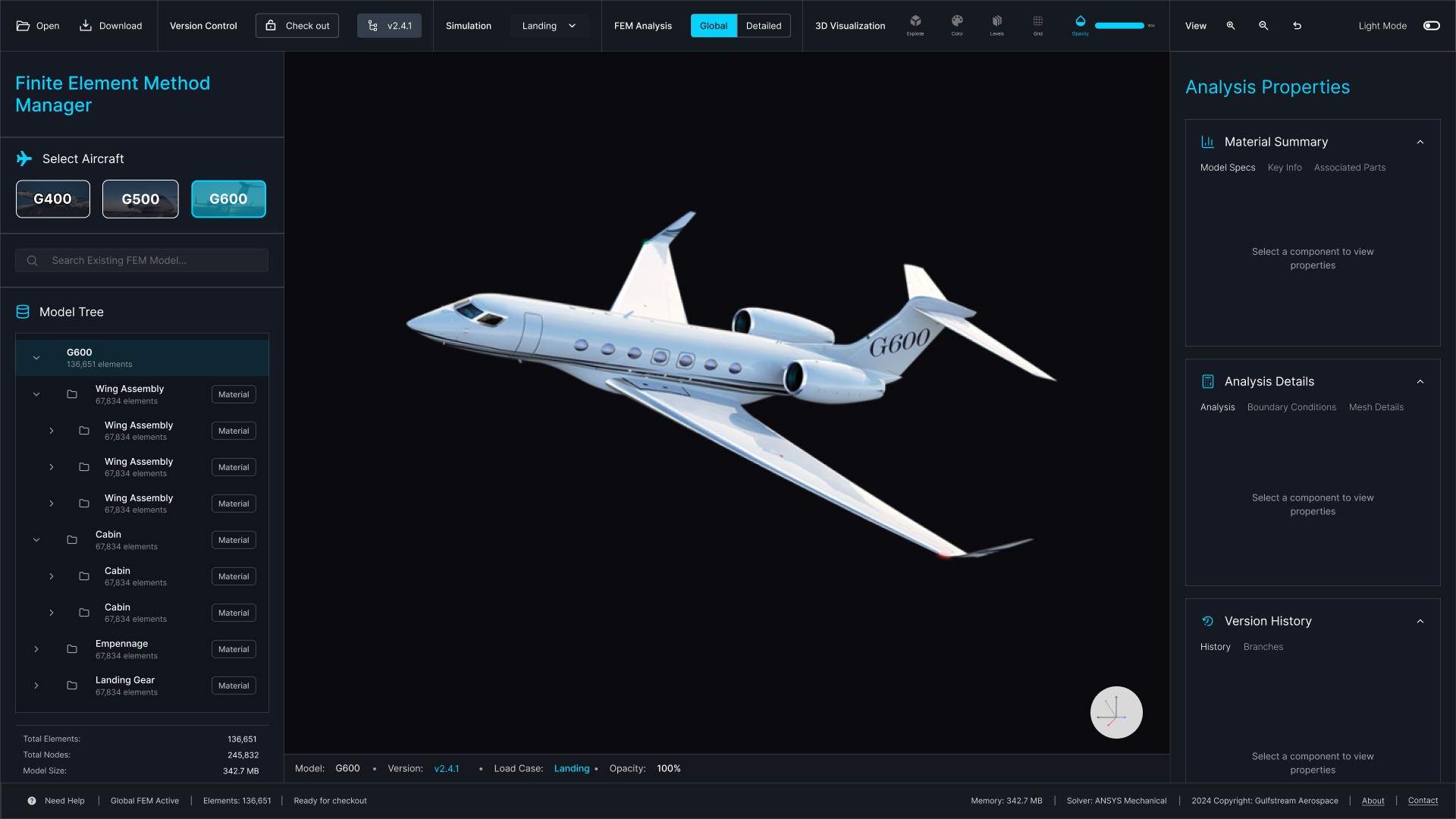
Global Finite Element Method (GFEM) Manager
Detail Finite Element Method (DFEM) Manager
Strain Gauge Visualizer
Stress Analysis AI Chatbot
My main focus was designing full end-to-end products for the GFEM and DFEM managers. These tools needed to help stress analysts and structural engineers work more efficiently while improving collaboration across different teams.
Process
Understanding engineers and their workflows
To ensure my designs were backed by real user data, I took a mixed-methods research approach:
Learning how engineers actually work
User interviews with individual engineers I spoke with stress analysts, structural engineers, and design engineers to understand their daily workflows, pain points, and what they needed from new tools.
Focus groups with multiple user groups I brought together different teams to understand how they collaborate and where their current process breaks down.
Task analysis of current tools and processes I observed engineers using existing stress analysis tools to understand their mental models and their workflows.
Usability testing to validate designs I tested my prototypes with engineers throughout the design process, gathering feedback and iterating based on what I learned.
Impact
What I designed and why it mattered
Translating complex technical requirements into intuitive solutions
Aerospace engineers work with incredibly complex data and simulations. My challenge was to design applications that made this complexity manageable without oversimplifying the technical data engineers needed.
Reimagining what engineering tools could be
I led a design exploration on what the future of engineering tools could look like at Gulfstream. This involved redefining the visual design language and interaction patterns that engineers were accustomed to.
Why this mattered: Engineers have mental models of how engineering tools should look and feel. Introducing modern design patterns required careful balance between innovation and familiarity.
Seeing my designs come to life
One of the most rewarding parts of my internship was handing off my designs to the front-end engineer and 3D graphics developer, then watching them being developed in real-time. This collaboration taught me how to design with technical constraints in mind and communicate design decisions effectively to engineering teams.
Internship Highlights
The impact
Recognition across the department
I presented my work to the entire Stress Analysis department and received recognition from the director during the departmental all-hands meeting. The positive response validated that my research-driven approach and design decisions resonated with both users and leadership.
Hands-on collaboration across disciplines
I worked closely with:
Stress analysts, design engineers, and structural engineers to understand user needs
UX Engineering Intern, 3D graphics developers, Front-end and back-end engineers explore technical feasibility and implement designs
A Product Owner to prioritize features and plan the roadmap
This cross-functional collaboration taught me how different roles think about problems and how to communicate design value to technical stakeholders.
Key Takeaways